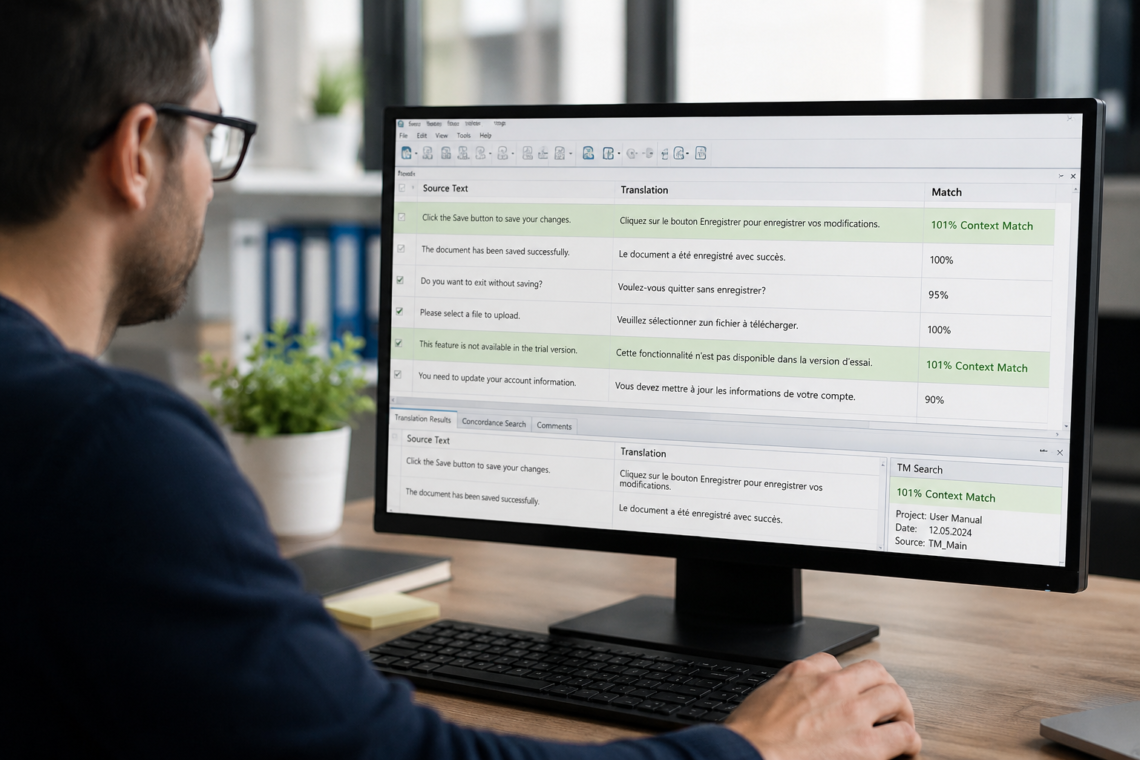
A context match is one of the most useful features in modern translation and localization workflows. It is commonly used in CAT tools, also known as computer-assisted translation tools, to improve translation accuracy and consistency. Many translators, agencies, and localization teams rely on context matching to save time while maintaining high-quality results across projects.
In simple terms, a context match happens when a sentence matches perfectly with a previously translated sentence and also appears in the same surrounding context. Because both the content and the position are similar, the translation tool gives translators more confidence that the existing translation is correct. In many CAT tools, this type of match is displayed as a 101% match instead of a normal 100% exact match.
Context matching has become especially important in software localization, technical documentation, website translation, and multilingual business communication. Companies that regularly update content can benefit from faster workflows and more consistent terminology. At the same time, translators can reduce repetitive work and focus more on quality review instead of translating the same content repeatedly.
Understanding The Meaning Of Context Match
A context match is different from a normal exact match because it checks more than just the sentence itself. Traditional exact matches only compare the current text with a previously translated segment. A context match goes further by checking the surrounding information connected to that sentence.
For example, imagine the sentence “Save Changes” appearing inside a software interface. The same phrase may appear in different sections of an application. In one place it may relate to account settings, while in another it may apply to document editing. Even though the wording is identical, the surrounding context can affect translation choices in some languages. A context match helps the CAT tool understand whether the sentence appears in the same environment as before.
This additional layer of verification improves translation reliability. It reduces the risk of reusing translations in the wrong situation and helps translators maintain consistency across large projects.
How Context Match Works In CAT Tools
CAT tools use translation memory systems to store previously translated content. Every time a translator completes a sentence, the tool saves the source text along with its translated version. Some tools also save surrounding data such as neighboring sentences, document structure, formatting, IDs, or segment order.
When a new project is opened, the CAT tool scans the translation memory database to find matches. If the sentence is identical and the surrounding conditions also match, the tool marks it as a context match. This gives translators a stronger signal that the translation can be reused safely.
Different CAT tools handle context matching differently. Some rely on previous and next segments, while others use document identifiers or software strings. Despite these differences, the overall purpose remains the same: improving translation quality and reducing unnecessary work.
Modern localization platforms often combine context matching with terminology management and quality assurance checks. This creates a more efficient workflow for both freelance translators and enterprise localization teams.
Context Match Vs Exact Match
Many people confuse context matches with standard exact matches, but they are not identical. A 100% exact match simply means the sentence itself is identical to a previously translated segment. It does not guarantee that the sentence appears in the same situation.
A context match provides stronger confirmation because the tool verifies the surrounding environment. This makes it more reliable in projects where meaning depends heavily on context.
For example, the word “Home” can refer to a website homepage, a house, or a mobile app navigation button. An exact match may reuse a translation incorrectly if the surrounding context changes. A context match reduces this risk by checking where the segment appears.
This distinction is especially important in languages where wording changes depending on grammar, gender, or user interface context. Translators often trust context matches more than standard exact matches because they usually require less editing and review.
Why Context Match Is Often Called A 101% Match
Many CAT tools label context matches as 101% matches. This percentage may seem unusual at first, but it simply indicates that the match is stronger than a regular 100% exact match.
The extra one percent does not represent mathematical accuracy. Instead, it acts as a practical label that tells translators the match includes additional contextual verification. In some tools, advanced forms of context matching may even appear as 102% matches.
The idea behind this system is to help translators quickly identify which segments are most reliable. A translator reviewing hundreds or thousands of segments can prioritize attention more effectively when strong context matches are clearly marked.
This approach also improves project management. Agencies and localization teams can estimate workloads more accurately because context matches usually require less editing time compared to fuzzy matches or untranslated content.
Benefits Of Context Match For Translators
One of the biggest advantages of context matching is improved efficiency. Translators working on large projects often encounter repeated content across manuals, websites, software interfaces, and product updates. Context matching allows them to reuse approved translations without manually checking every repeated sentence.
Another important benefit is consistency. Using the same translation in the correct context helps maintain a unified writing style across documents. This is especially important for technical industries, software products, healthcare content, and legal documentation where consistency directly affects clarity and user understanding.
Context matching can also reduce translator fatigue. Repetitive translation tasks can become mentally exhausting over time. When translators can confidently reuse reliable segments, they can focus more energy on difficult or creative parts of the project.
Experienced translators often appreciate context matches because they improve workflow speed without lowering quality standards. However, professional translators still review strong matches carefully, especially in sensitive industries where accuracy is critical.
Benefits Of Context Match For Businesses And Localization Teams
Businesses that manage multilingual content can gain major advantages from context matching. Faster translation workflows often lead to shorter project delivery times, which is valuable for companies operating in global markets.
Consistency is another major benefit. Brands that publish content in multiple languages need stable terminology and messaging across regions. Context matching helps ensure that recurring phrases are translated in a uniform way throughout websites, applications, support articles, and product documentation.
Cost efficiency is also an important factor. Because context matches require less editing and review, translation costs may decrease over time. This becomes especially valuable for companies that update software or documentation regularly.
Localization managers also benefit from better quality control. Since context matches are usually based on approved previous translations, the risk of inconsistent wording becomes lower. This creates a smoother review process and improves overall translation reliability.
Common Misunderstandings About Context Match
Some people assume that context matches never need human review, but this is not always true. Even strong matches can contain outdated terminology or translations that no longer fit updated branding guidelines.
Another misunderstanding is that all CAT tools calculate context in the same way. In reality, each platform may use different methods for evaluating surrounding information. One tool may rely on neighboring sentences, while another may use document structure or segment identifiers.
Some users also confuse context matches with perfect matches. Although the concepts are similar, they are not always identical. Certain tools define perfect matches differently depending on workflow settings and file structures.
Professional translators understand that context matching is a support feature rather than a replacement for human judgment. Even highly reliable matches should be reviewed carefully in industries where accuracy and compliance are essential.
Context Match And Translation Quality
High-quality translation depends on more than vocabulary alone. Meaning often changes depending on where a sentence appears and how it connects with surrounding content. Context matching helps translators maintain natural wording by preserving these relationships.
This is particularly useful in software localization and website translation. User interface text is often short and can have multiple meanings when viewed separately. Context-aware matching reduces confusion and improves user experience in translated products.
Translation quality also improves because context matches encourage consistency across projects. Readers notice when terminology changes unexpectedly between pages or software screens. Stable wording creates a more professional and trustworthy experience for users.
Many experienced localization teams treat context matching as an important part of their quality assurance process. When combined with skilled human review, it can significantly improve both speed and accuracy.
Practical Tips For Using Context Match Effectively
To get the best results from context matching, translators and businesses should maintain clean translation memories. Poor-quality or outdated translations can reduce the reliability of future matches.
It is also helpful to separate translation memories by industry or project type. Mixing unrelated content into a single database can create confusion and increase the chance of incorrect matches.
Reviewing approved terminology regularly is another good practice. Even reliable context matches may require updates if company branding or industry standards change over time.
Translators should also pay attention to formatting, punctuation, and software variables. Small technical differences can affect how CAT tools detect context matches.
Experienced localization professionals often recommend combining context matching with manual review rather than depending on automation alone. This balanced approach usually produces the best long-term results.
Conclusion
Context match plays an important role in modern translation and localization workflows. It helps translators reuse reliable translations more confidently by checking both the sentence and its surrounding context. This improves consistency, saves time, and reduces the risk of translation errors in large multilingual projects.
Businesses, agencies, and freelance translators all benefit from context matching when it is used correctly. It supports faster project delivery, better terminology control, and more efficient quality assurance processes. At the same time, human review remains essential because language and meaning can still change depending on project requirements.
As translation technology continues to evolve, context match features will likely become even more advanced and accurate. For anyone working in localization, understanding how context matching works is an important step toward producing high-quality multilingual content that feels natural, clear, and consistent for readers around the world.
FAQ’s:
What Is A Context Match In Translation?
A context match is an exact translation memory match where the surrounding context also matches the previous translation.
Why Is A Context Match Called A 101% Match?
It is called a 101% match because the CAT tool confirms both the text and its context, making it more reliable than a standard 100% match.
Are Context Matches Always Accurate?
No, translators should still review them because outdated terminology or changes in meaning can affect accuracy.
Which Tools Use Context Matching?
Many CAT tools use context matching, including memoQ, Phrase, Trados-style platforms, and other localization systems.
How Does Context Match Help Businesses?
It improves translation consistency, reduces repetitive work, speeds up localization projects, and supports better quality control.
Craving more knowledge? Head over to my website for new articles.
Disclaimer
This article is intended for informational and educational purposes only. The information shared about context match and translation tools is based on general industry knowledge and research. Features and terminology may vary between different CAT tools and localization platforms. Readers should always verify technical details according to their specific software, workflow, or professional requirements.